
Declaration
Rothridge
Broadsides
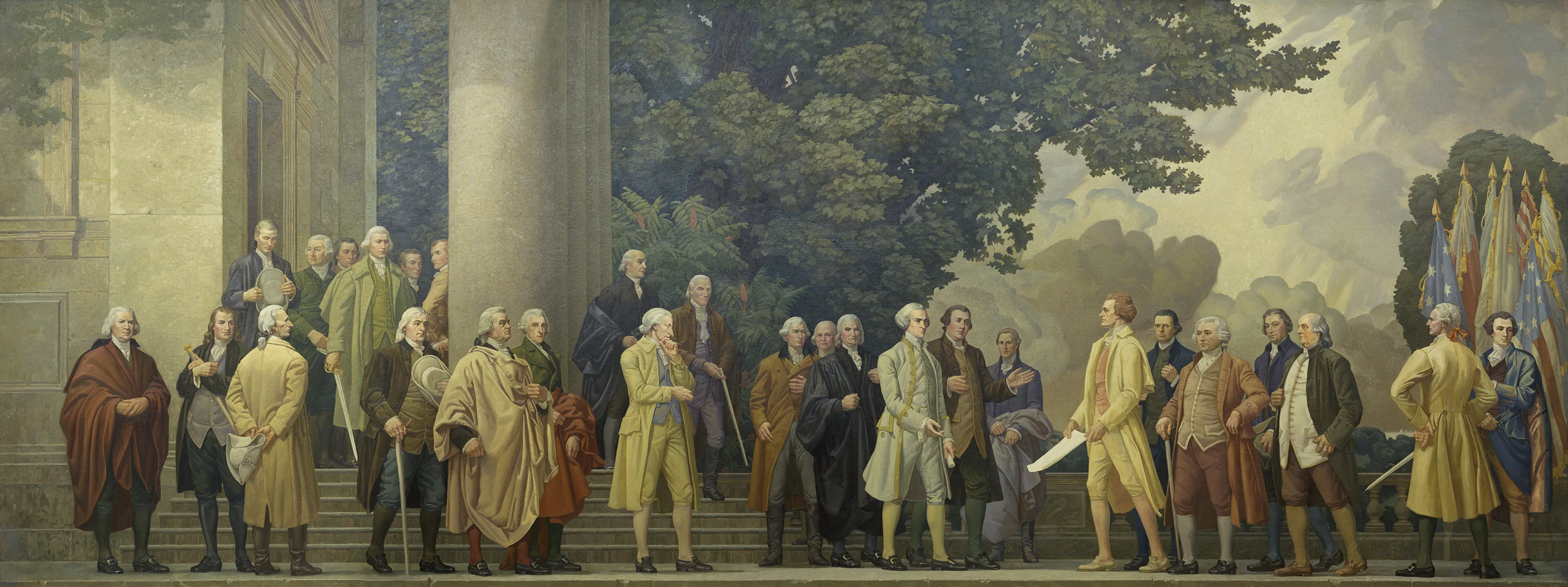
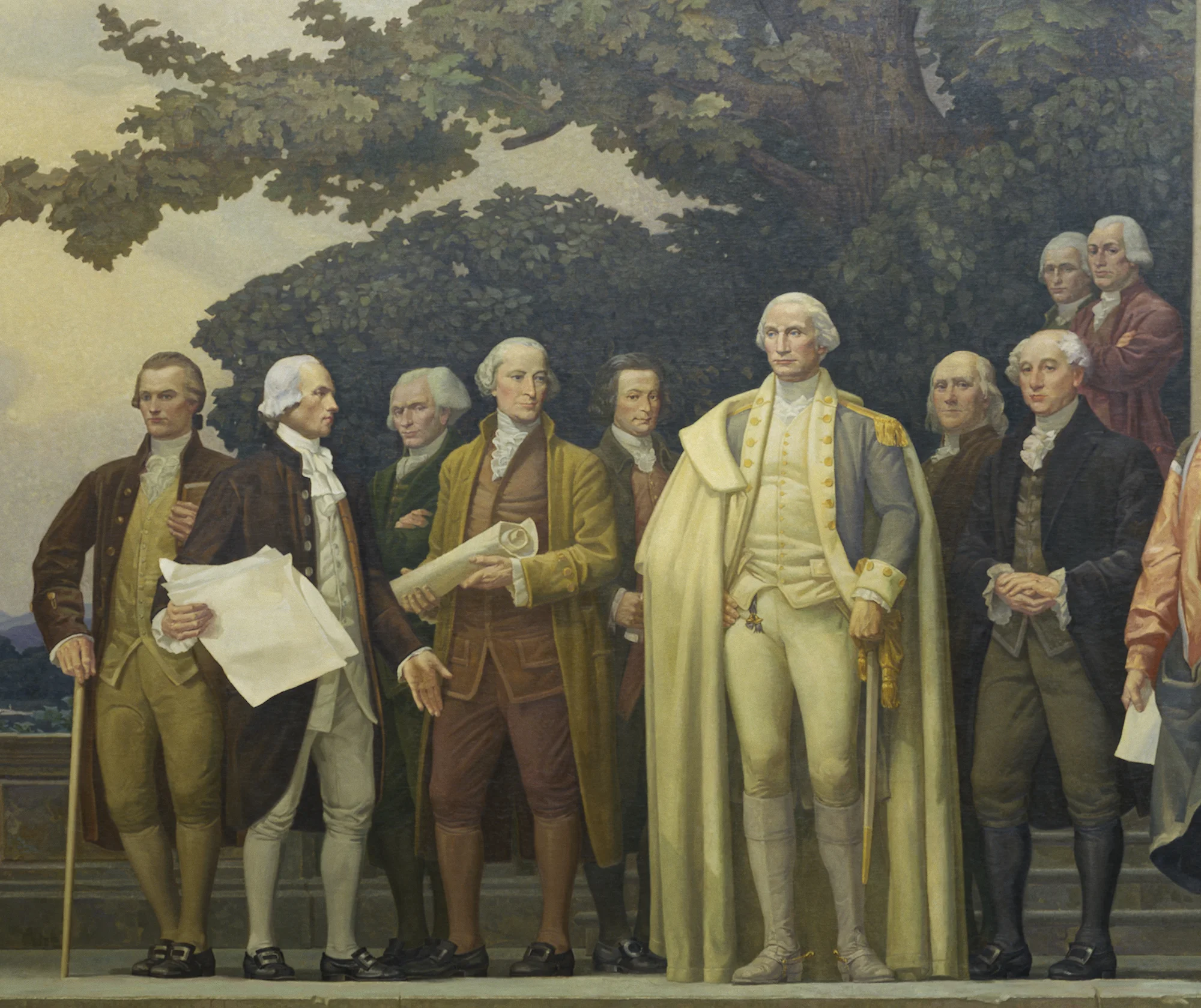
Declaration | Barry Faulkner
National Archives Rotunda, Washington D.C.
The substantial oil-on-canvas mural depicts an allegorical scene of Thomas Jefferson presenting the Declaration to Congress President John Hancock. Twenty-eight prominent men from the original Thirteen States are portrayed.
1936 | 14' x 37.5'


Declaration
Broadside Print
$250
• Free Shipping
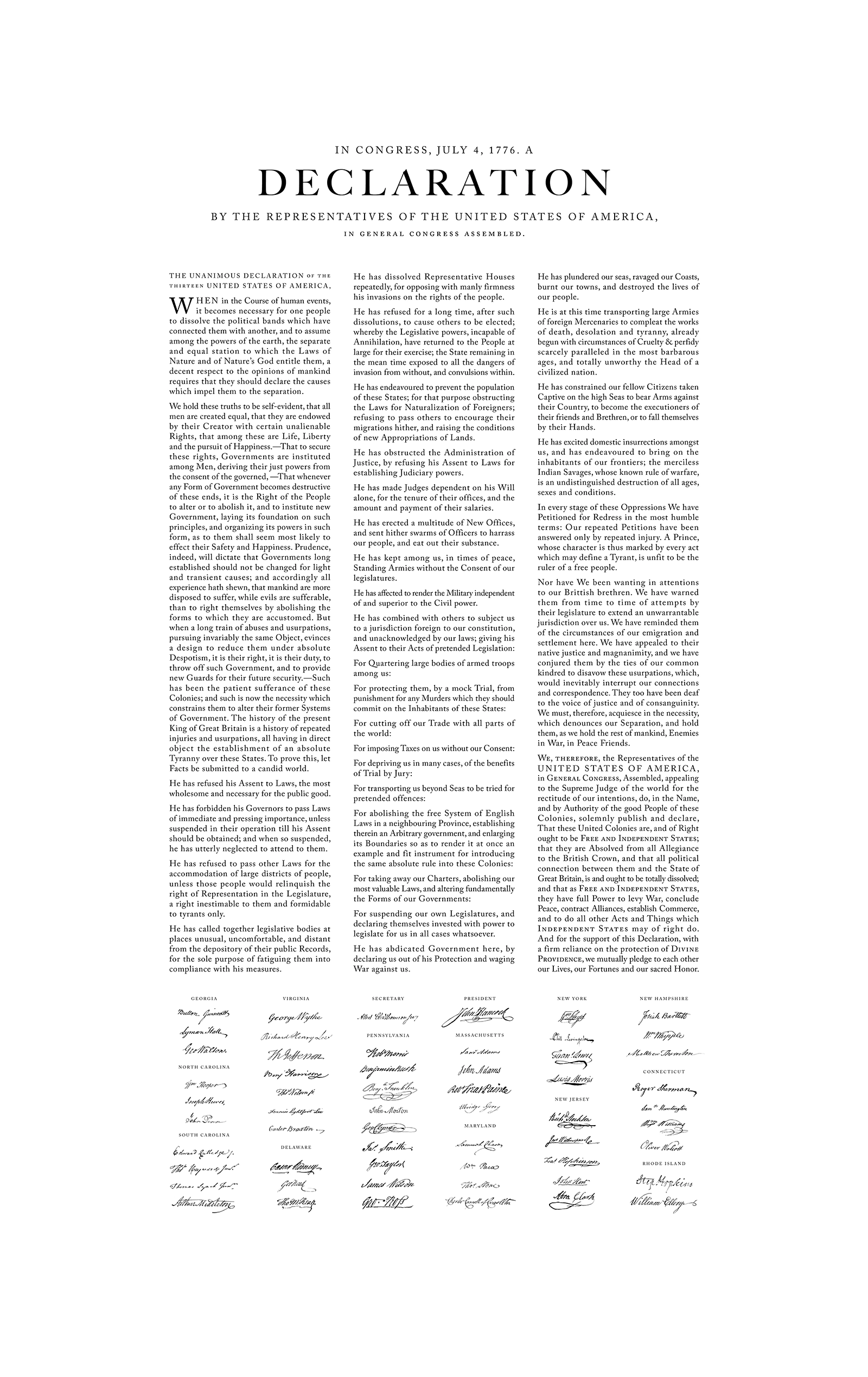
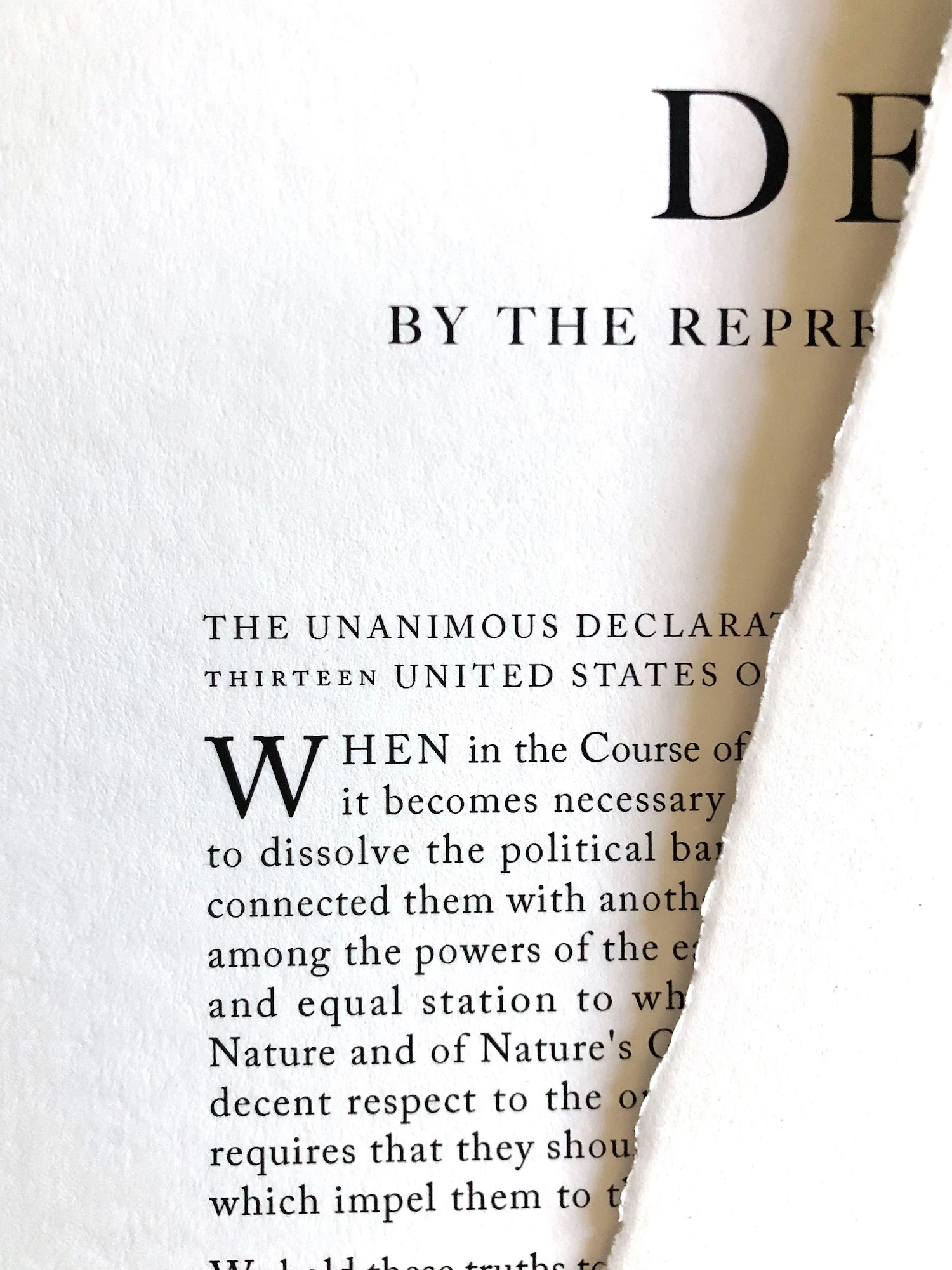
Penned, signed, and printed under the threat of execution for high treason, the Declaration of Independence established the United States of America as free and independent states and is once again presented as a printed broadside.
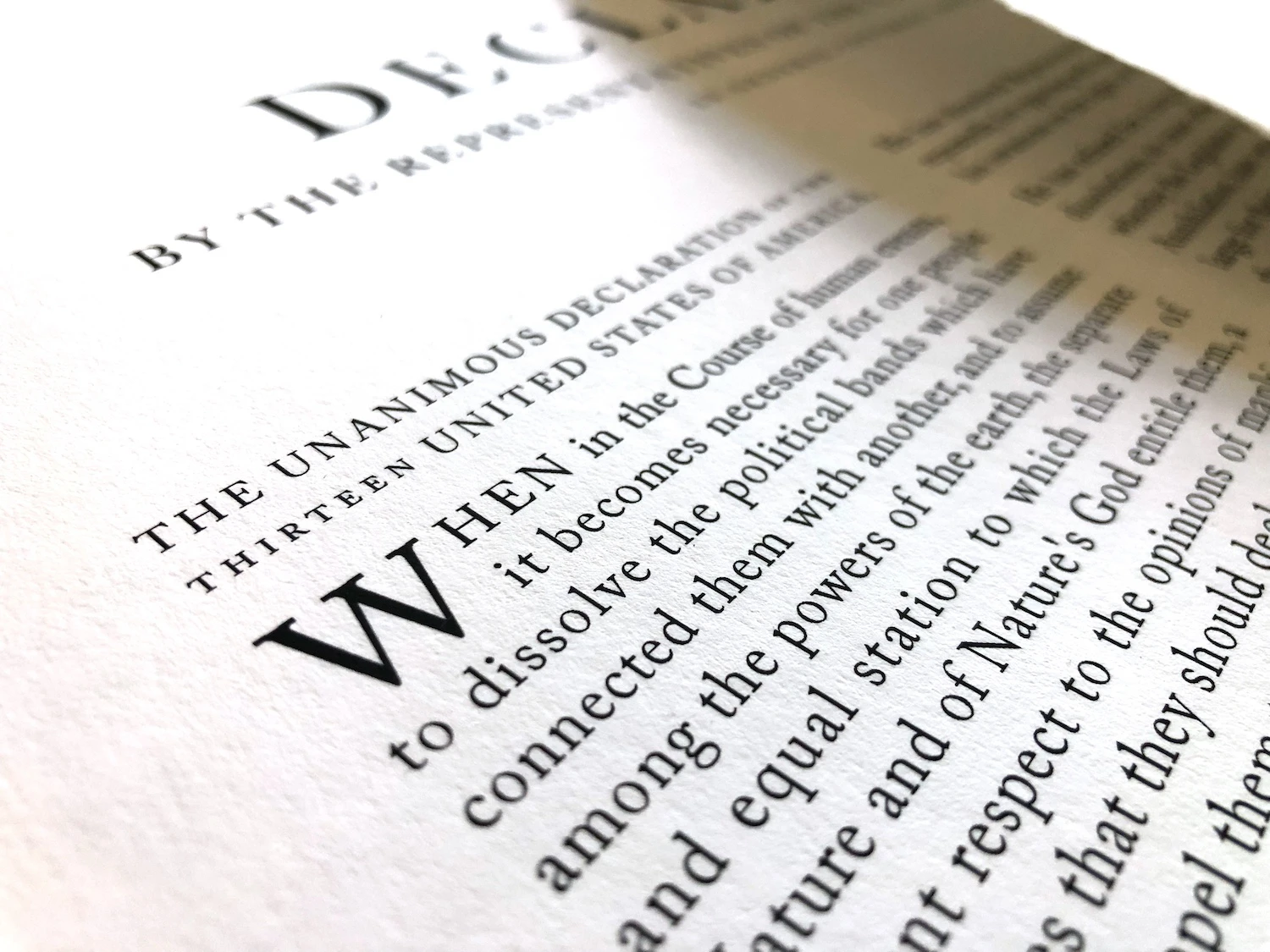
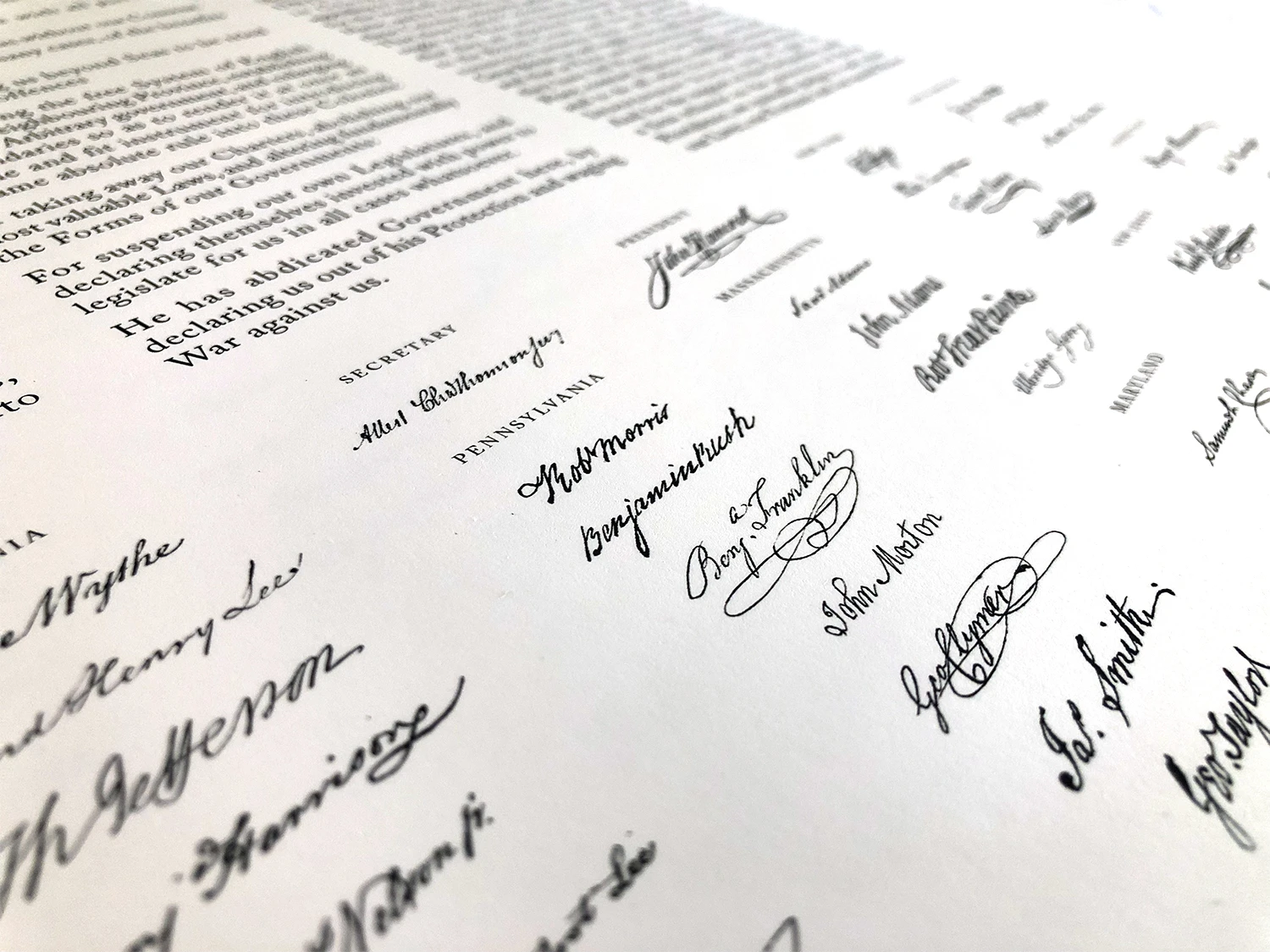
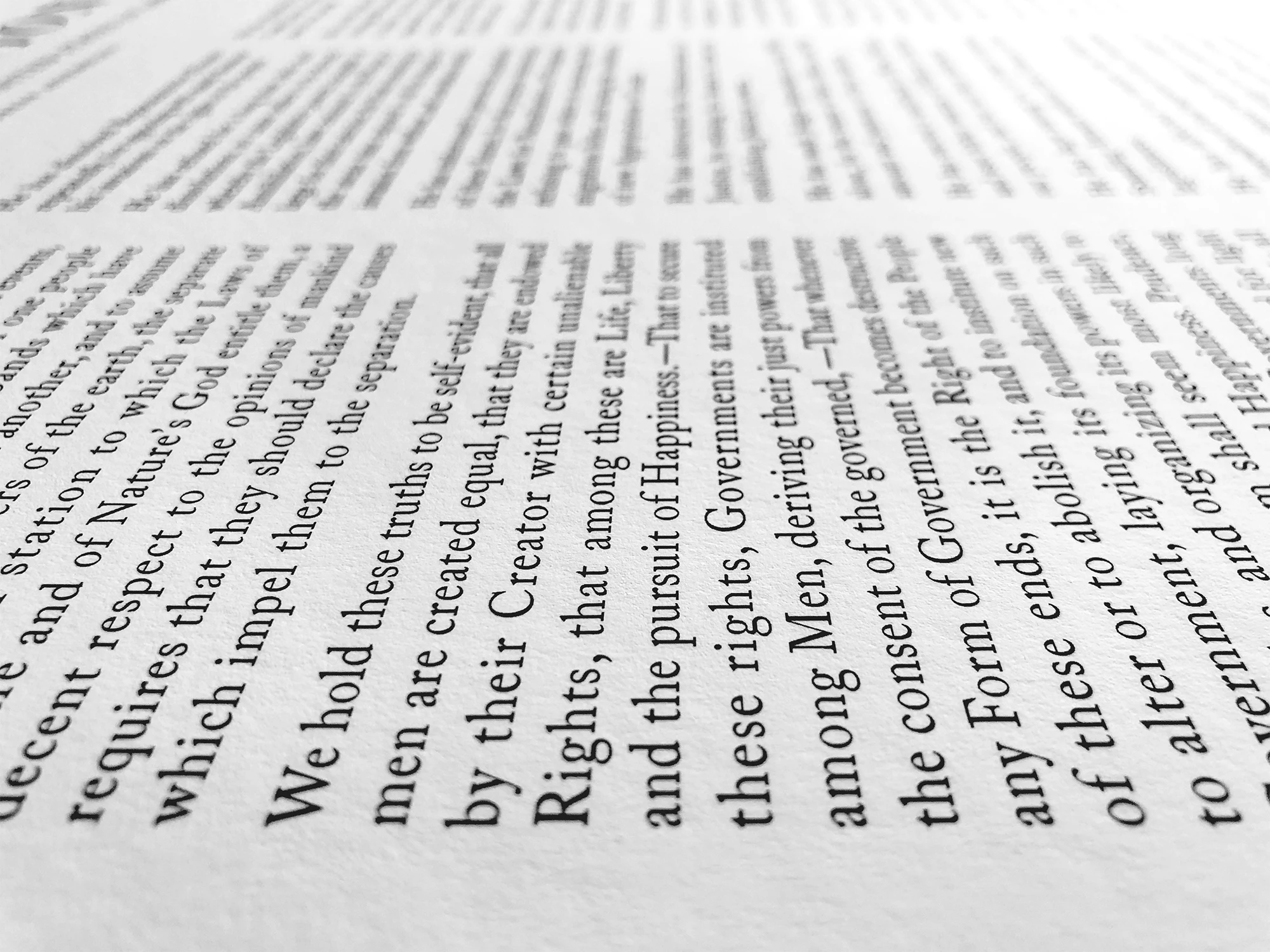
The Rothridge Broadside of the Declaration features the full text of the official Engrossed Declaration, accompanied by facsimile signatures of the fifty-six Signers and Secretary Charles Thomson.
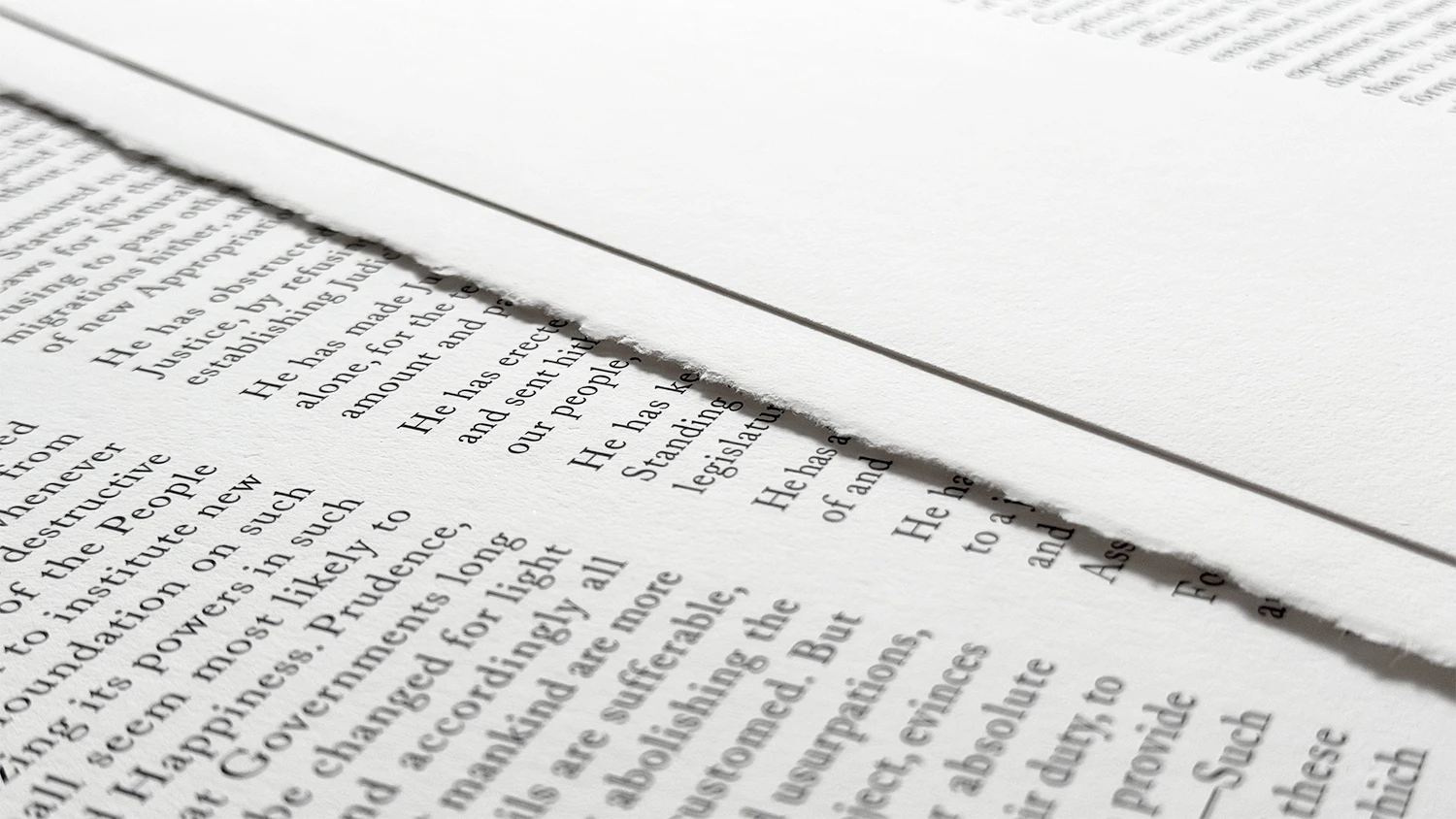
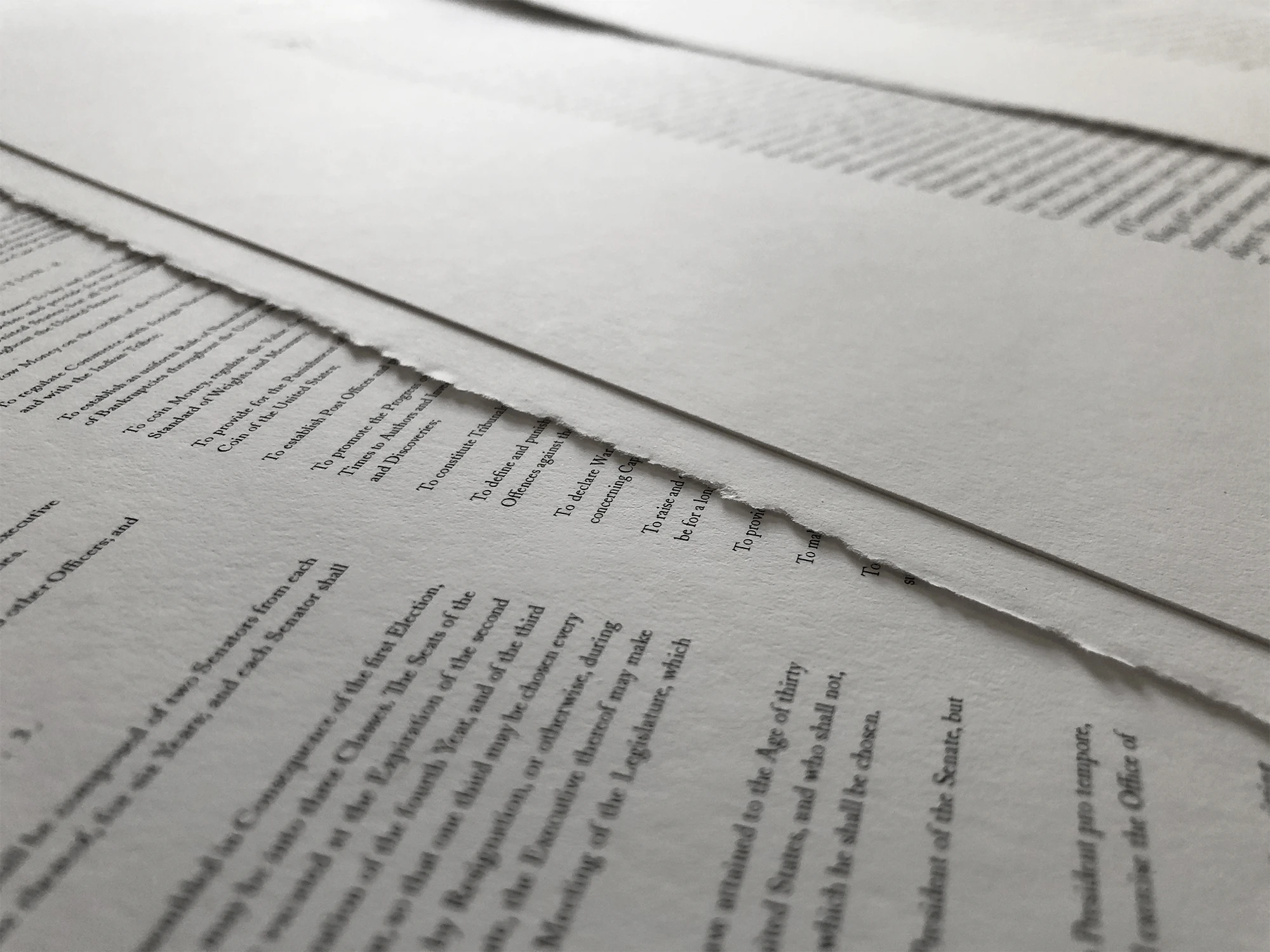
With a refinement that can be seen and felt, the museum-grade fine-art paper has a smooth uncoated matte surface designed for heirloom printing. Contrasting the crisp white of the 100% cotton paper, the use of archival black ink preserves the naturally archival quality of the cotton fibers, allowing the Broadside to endure for generations to come.
As a statement piece, the Broadside measures 32.5"x20.5" and is designed to rest just within the proportions of a 3'x2' frame, allowing the attractive clean cut or deckled edges to remain visible.
Careful study, intentional design and a thoughtful consideration for the history of each document ensure the Rothridge Broadsides of America’s Founding Documents are a sincere tribute to America’s history and her Founding Fathers.
- Engrossed Declaration Text
- Charles Thomson Signature
- Facsimile Signatures
- Caslon Typeface
- Both Original Titles
- Fits 2'x3' Frame
Museum-Grade
Considered selection of paper, ink and printing process ensure a print with exceptional fidelity that will last for generations.
20.5"W • 32.5"H
100% Cotton
Archival
Made In U.S.A.
Discover the Broadside
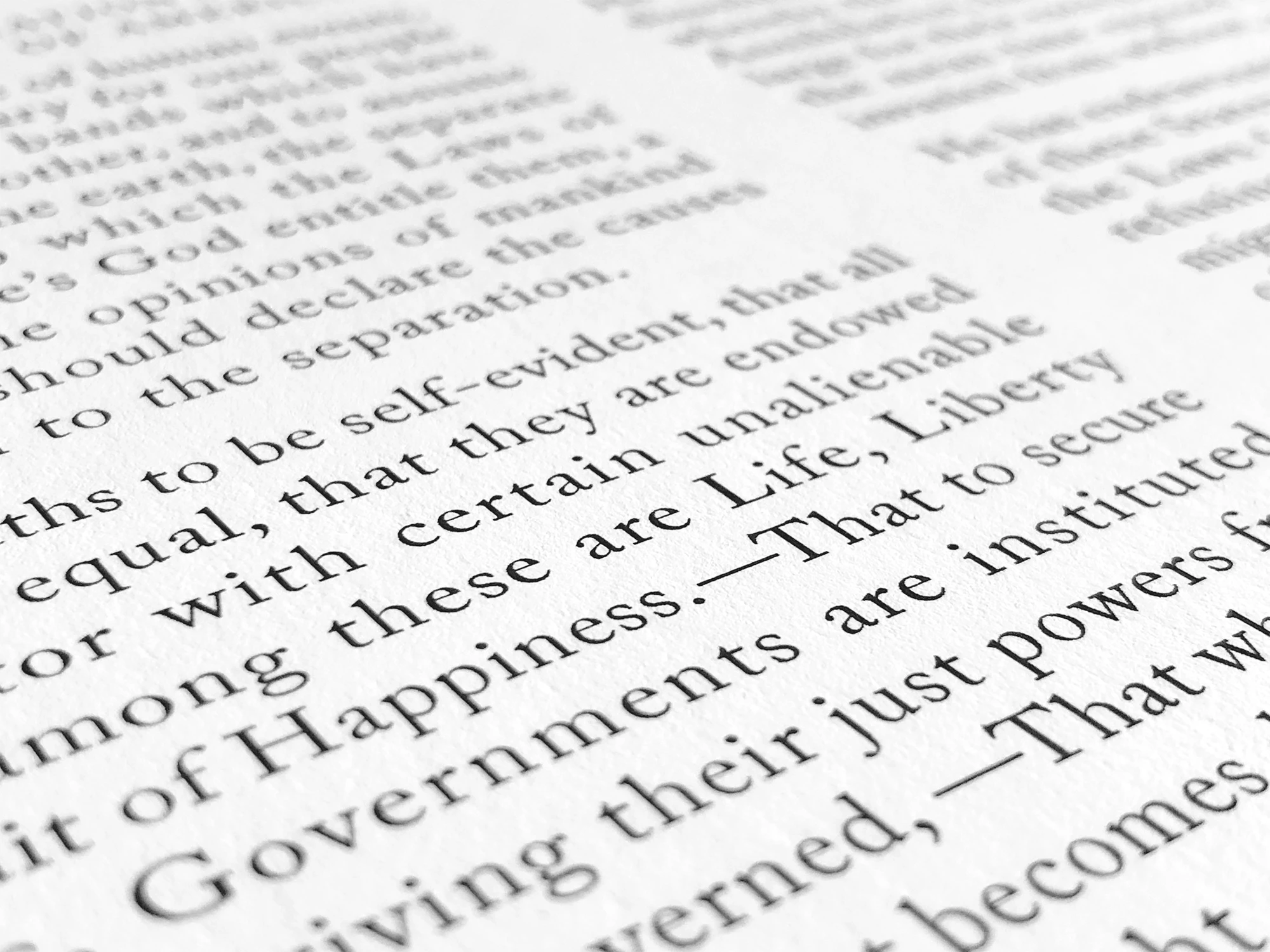
“You will think me transported with Enthusiasm but I am not. – I am well aware of the Toil and Blood and Treasure, that it will cost Us to maintain this Declaration, and support and defend these States. – Yet through all the Gloom I can see the Rays of ravishing Light and Glory.”
Letter to his wife Abigail
July 3, 1776
250
Years
of America
Semiquincentennial Printings
Commemorating America’s 250th year of Independence, each broadside printed this year bears the semiquincentennial crest.
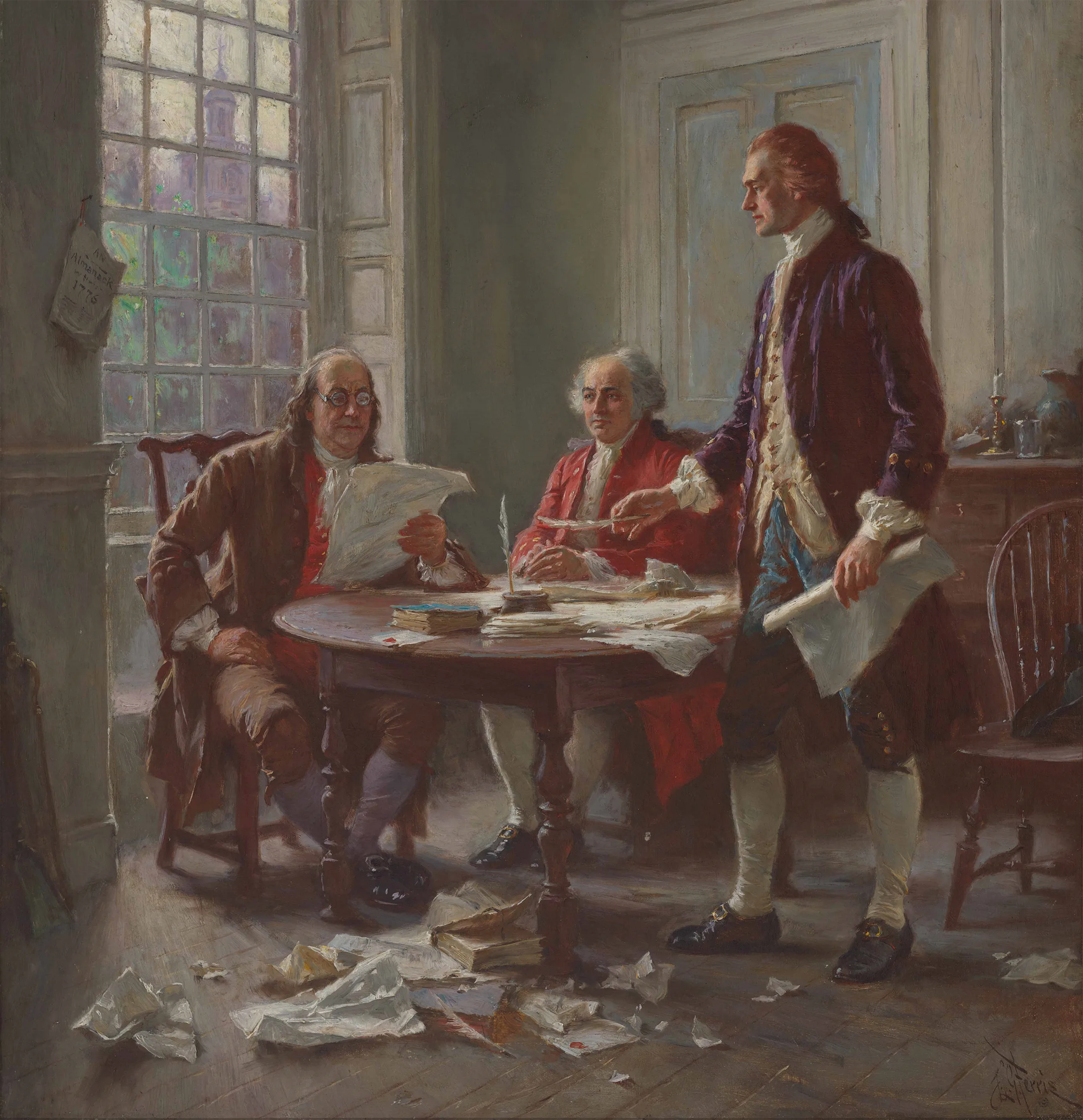
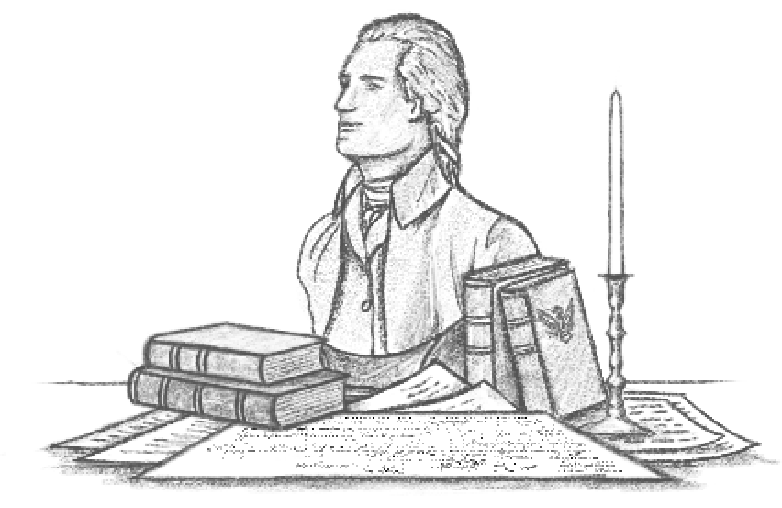
The Writing of the Declaration of Independence | Jean Leon Gerome Ferris
Virginia Museum of History & Culture
Depicting Benjamin Franklin, John Adams and Thomas Jefferson drafting the Declaration of Independence, this painting is part of a series by Ferris called The Pageant of a Nation.
1921 | 31' x 25'
Texts of Liberty
E Pluribus Unum
Following the vote for Independence on the 2nd of July, the text of the Declaration was shared throughout the newly Independent States by both sight and sound, beginning with the July 4th Dunlap Broadsides.
A careful study of the revolutionary text in its various official forms provided the opportunity for a renewed broadside, one that embraces the history of America’s founding document while also presenting the text as it appears on the original Engrossed Declaration.
The Rothridge Broadside of the Declaration is not only an elegant blend of its predecessors, but also a reflection of America’s founding heritage and a keepsake for future generations.
Accurate Transcription
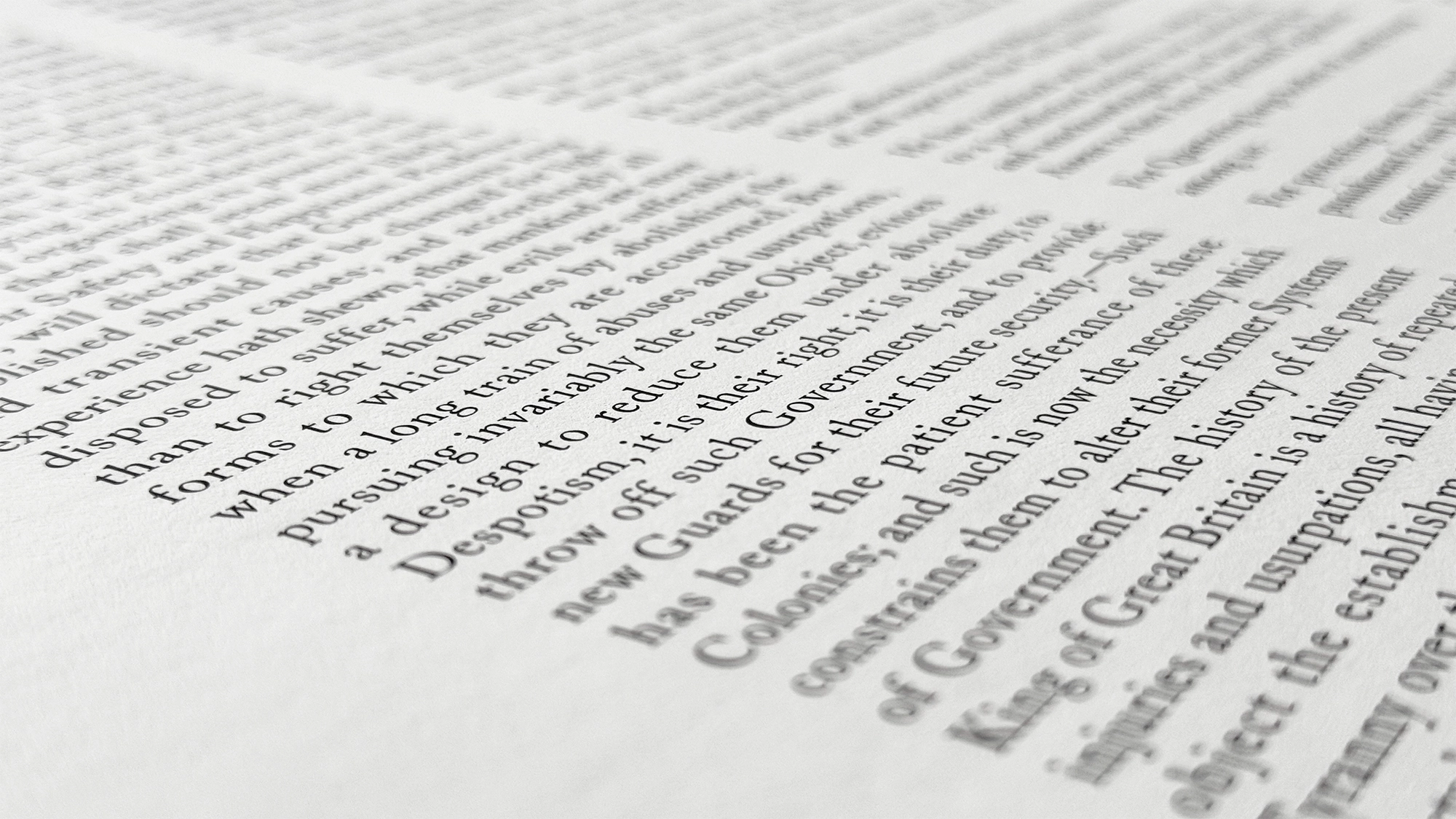
Engrossed Declaration Text
As the original Engrossed Declaration has faded significantly, most transcriptions rely on early printings and facsimiles, each with subtle differences in style of punctuation and capitalization.
In order to present the text of the original, a careful study of the Declaration records was required. Not only providing a clean and accurate transcription, but also identified a missing comma in the National Archive’s official transcription, which they promptly corrected when notified.
Original Titles
Ordered by Continental Congress
“In Congress, July 4, 1776. A Declaration by the Representatives of the United States of America, In General Congress Assembled.”
Dunlap Broadsides
July 4, 1776
With the New York delegates authorized on July 9th to approve the Declaration, Congress ordered on July 19 that it be engrossed with a new title reflecting the unanimous vote.
“In Congress, July 4, 1776. The Unanimous Declaration of the Thirteen United States of America.”
Engrossed Declaration
August 2, 1776
Emphasized Words
Three official versions
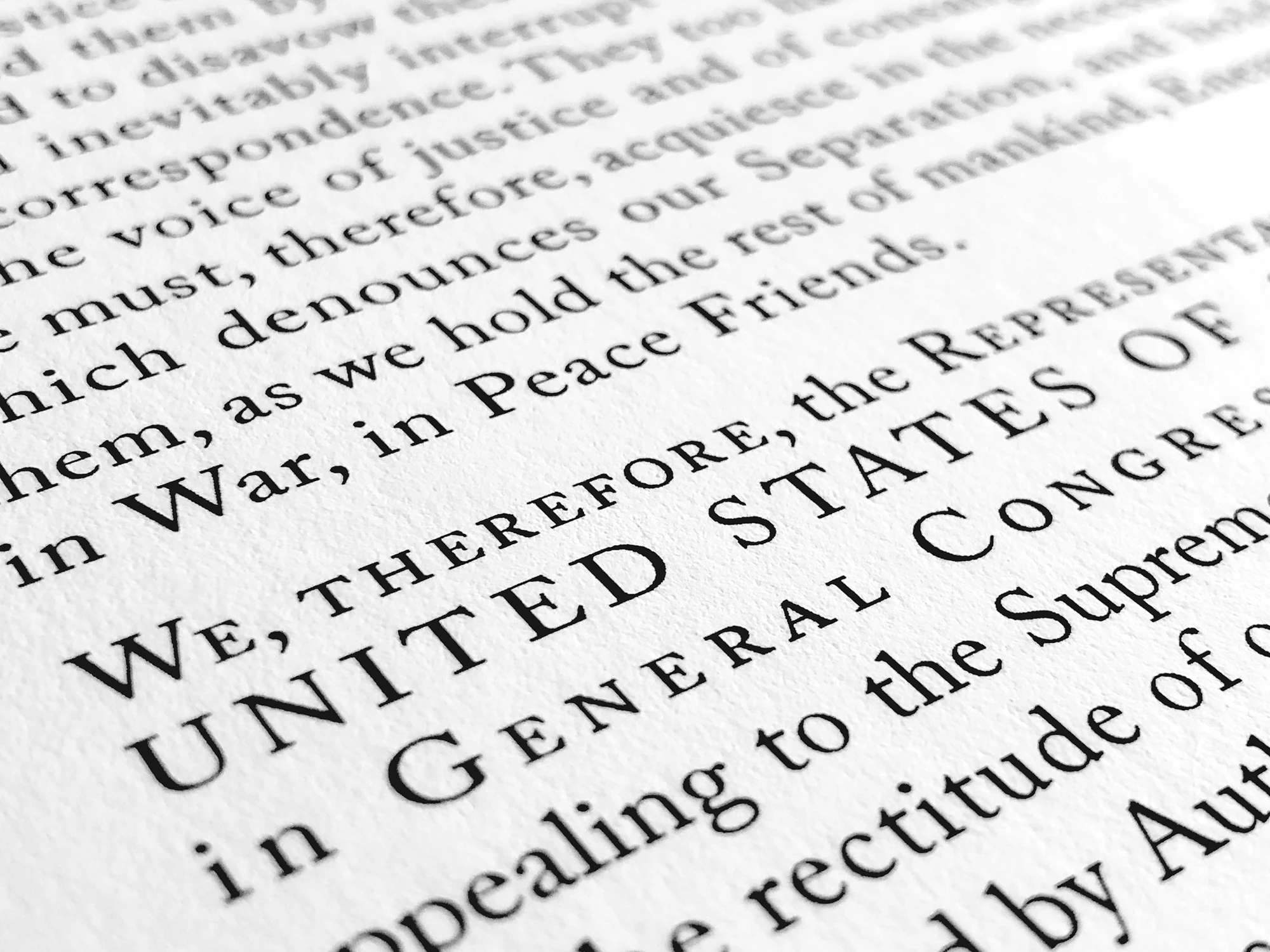
Some words in the Engrossed Declaration as well as the Dunlap Broadsides and Goddard Broadsides were emphasized using combinations of capitalization, full uppercase, and small capitals. Each version varies slightly on which words were emphasized. Because all three were authorized by the Continental Congress, the Rothridge Broadside reflects the emphasized words found in each.
Fair Copy
June 28, 1776
A Fair Copy, written by Thomas Jefferson on behalf of the Committee of Five, was presented to Congress and “laid on the table”. The Committee having been tasked on June 11, 1776 with drafting a formal Declaration of Independence. This moment is depicted in John Trumbull’s painting The Declaration of Independence, located in the rotunda of the United States Capitol.
This document was then debated and revised, being approved on July 4, 1776.
After being taken to John Dunlap for printing, there is no further record of the Fair Copy being extant. Possibly being destroyed in the printing process or in keeping with the secrecy protocols of Congress at the time.
Surviving personal four-page folio Fair Copies, also written by Jefferson and shared with friends and associates, feature the original text, including his condemnation of the slave trade, as well as edits made by the Committee and the Continental Congress.
4-Page Folio 12.6" x 7.9"
Dunlap Broadsides
July 4 - July 19, 1776
Printed on the night of July 4th 1776, in Philadelphia by John Dunlap, the official printer of the Continental Congress, likely with the help of his nineteen-year-old apprentice, David Claypoole.
The only names appearing on this version, aside from printer John Dunlap, were those of the two men to actually sign the text of the Declaration on July 4th, Congress President John Hancock and Secretary Charles Thomson. They likely signed the Fair Copy with its approved revisions, their signatures being required to authenticate any official documents of the Continental Congress, before it was taken to John Dunlap for printing.
The Committee of Five were tasked with “supervising and correcting the press.” Though we do not have a record of who fulfilled this request, it is possible that all five men, as well as Secretary Thomson, were present that night.
The Rough Journals of the Continental Congress include a Dunlap Broadside affixed with wafers. The Transcript Journals feature a transcription of the Dunlap Broadsides.
18.5" x 14.9"
Engrossed Declaration
July 19 - August 2, 1776
The Official Declaration of Independence, housed in the National Archives in Washington, D.C.
Ordered Engrossed, written in a clear and attractive hand, by Congress on July 19 and completed by the talented Timothy Matlack, the assistant to Secretary Charles Thomson.
Though we do not know the exact sources Matlack used as he engrossed the Declaration, we do know it was “compared”, and is an elegant blend of the styling of the available source texts: the Fair Copy, if still extant; the Dunlap Broadside printings; and the Journals of Congress, if completed. A second Dunlap Broadside printing, with newly set type on vellum, was printed on July 19, likely in preparation for the Engrossed Declaration, ordered the same day.
Signed by most of the fifty-six Signers on August 2, 1776, in the East Room of Independence Hall in Philadelphia. Entrusted to the custody of Secretary Thomson during the Revolutionary War, it would remain in his charge for thirteen years.
29.5" x 24"
Goddard Broadsides
January 18, 1777
As the war continued, the Continental Congress was temporarily relocated from Philadelphia to Baltimore due to the threat of British occupation. During this time, Congress ordered the second official printing of the Declaration on January 18, 1777, printed by Mary Katherine Goddard. These printings were to be sent to each State as their official copy, and were the first to provide the names of the Signers.
Rather than printing under the name M.K. Goddard, Mary would take on a similar threat as the Signers and printed the Broadsides under her full name, becoming one of the first Daughters of the Revolution.
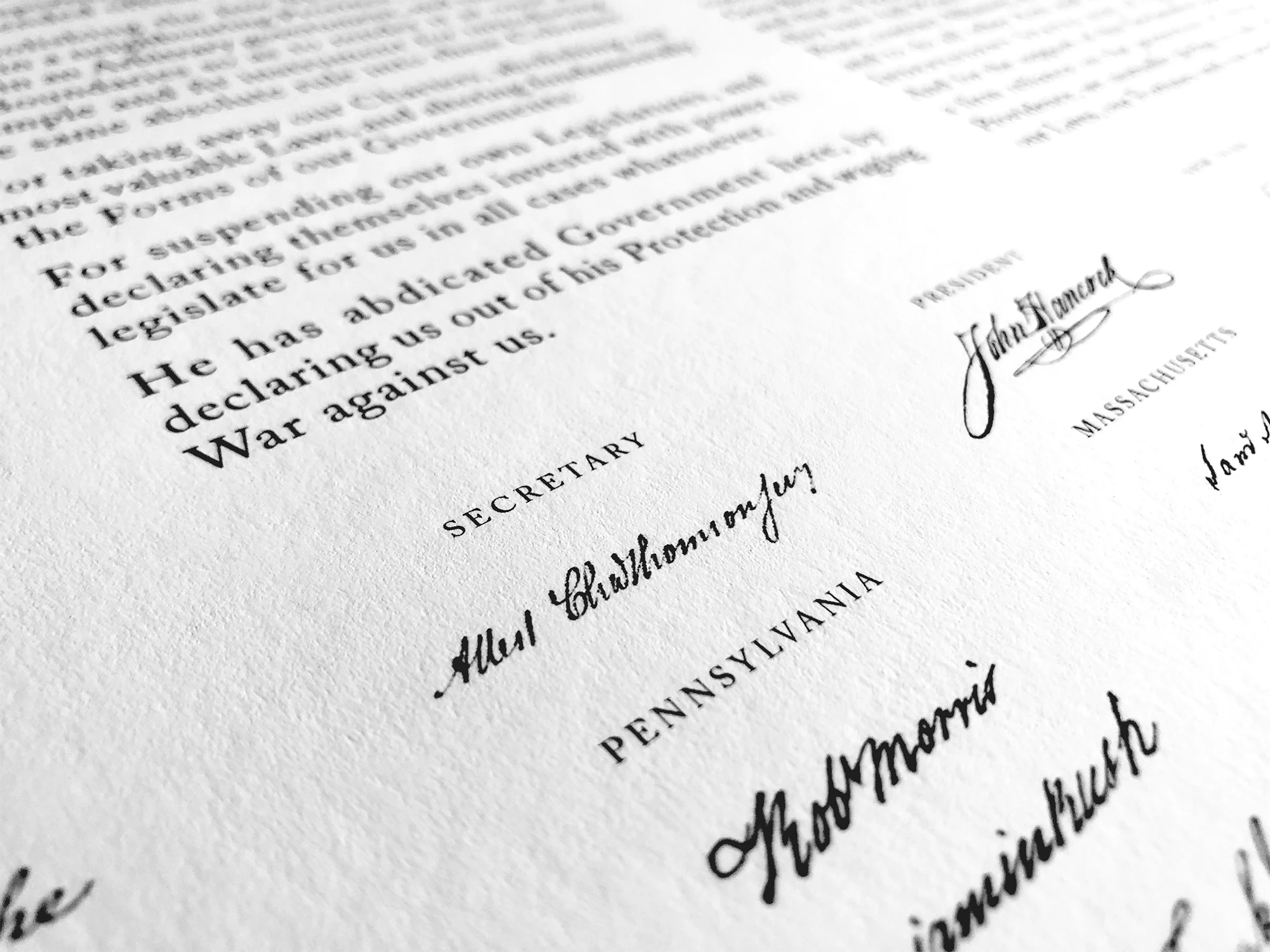
It is upon the surviving Goddard Broadsides we find again the signatures of President John Hancock and Secretary Charles Thomson. A New York copy provides the source of Secretary Thomson’s attest signature as featured on the Rothridge Broadside of the Declaration.
Following the Providential Christmas night Crossing of the Delaware, George Washington and his troops secured victories in the pivotal Battles of Trenton and Princeton, which enabled the Continental Congress to return to Philadelphia on February 27, 1777.
21.6" x 17.3"
Stone Facsimile
July 4, 1823
In the year 1820, Secretary of State John Quincy Adams commissioned William J. Stone to create a faithful facsimile of the original Engrossed Declaration. This endeavor was motivated in part by concern over the aging and deterioration of the original. After three years of dedicated work, Stone produced the 1823 copperplate engraving.
The exact process Stone used to create his facsimile of the Declaration is not known. However, many believe he may have used a wet transfer method known as a press copy. This technique would have involved moistening the original ink and pressing a sheet of paper against it to lift some of the ink. Unfortunately, this process likely contributed to the significant fading of the original document. This did however preserve the appearance of the original Declaration and is the image most reproduced.
On May 26, 1824, Congress ordered that two hundred vellum facsimiles be printed and distributed to various prominent institutions and individuals, including the surviving Signers. Paper copies were later printed.
30" x 24”
Weeks Facsimile
1939
Edward M. Weeks Sr., a master engraver at the U.S. Treasury’s Bureau of Engraving and Printing, was commissioned in 1936 to create a second facsimile of the Engrossed Declaration. His finished work is regarded as the most accurate facsimile available.
The steel engraving took 1,318 hours over a period of three years and was completed in 1939. It was based on the 1903 photograph of the original taken by Levin C. Handy.
Printed using a hand-operated Spider press, new copies are periodically made available from the U.S. Bureau of Engraving and Printing.
31" x 26”
“The Declaration of Independence was read, when Mr. Smith made a speech explaining the nature of and the advantages that independence would be of to us. When he finished his speech he threw up his hat and hurrahed for liberty and independence which was reiterated by the militia and all the men, women and boys.”
Adlum’s Memoirs at the age of seventeen
July 7, 1776
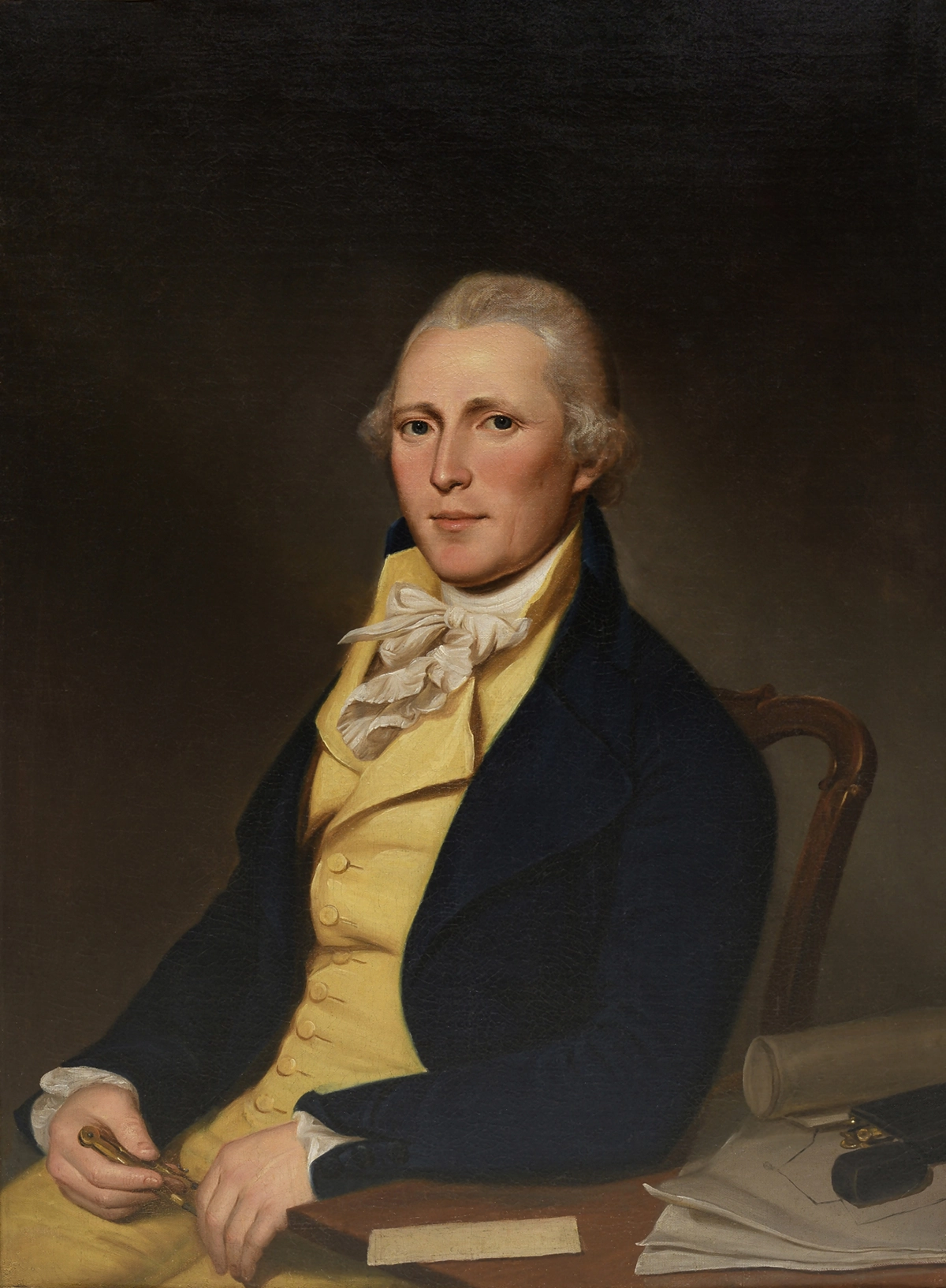
John Adlum | Charles Willson Peale
Courtesy of The State Museum of Pennsylvania, Pennsylvania Historical & Museum Commission
Born in York, Pennsylvania, John Adlum joined the fight for Independence at the age of 17, serving in the Continental Army under General George Washington. Captured and held as a prisoner of war for over a year, among those who survived imprisonment. He would go on to be a Land Surveyor, as referenced in the portrait items. He also served as an Associate Judge, and Captain in the War of 1812.
Adlum sat for the portrait at the age of 30, the painter Charles Peale having also painted the first known portrait of George Washington, elected President the same year.
1789 | 35.75" x 26.75"

Our Sacred Honor
Signatures
As each of the Signers took a quill pen from the Syng Inkstand, their impressive signatures would often overlap one another, a rather poetic example of E Pluribus Unum.
To display the Signers’ names individually, the delicate process of extracting each signature was required. The study of historic documents containing the men’s signatures provided a further understanding of how each man wrote his name, ensuring that no part was mistakenly removed or added.
The endeavor resulted in a pleasing display of each signature as found upon the original Engrossed Declaration, proportionally accurate to its fellow Signers, organized by state and in order of signing.
John Hancock’s famously large signature has been slightly scaled down to preserve aesthetics.
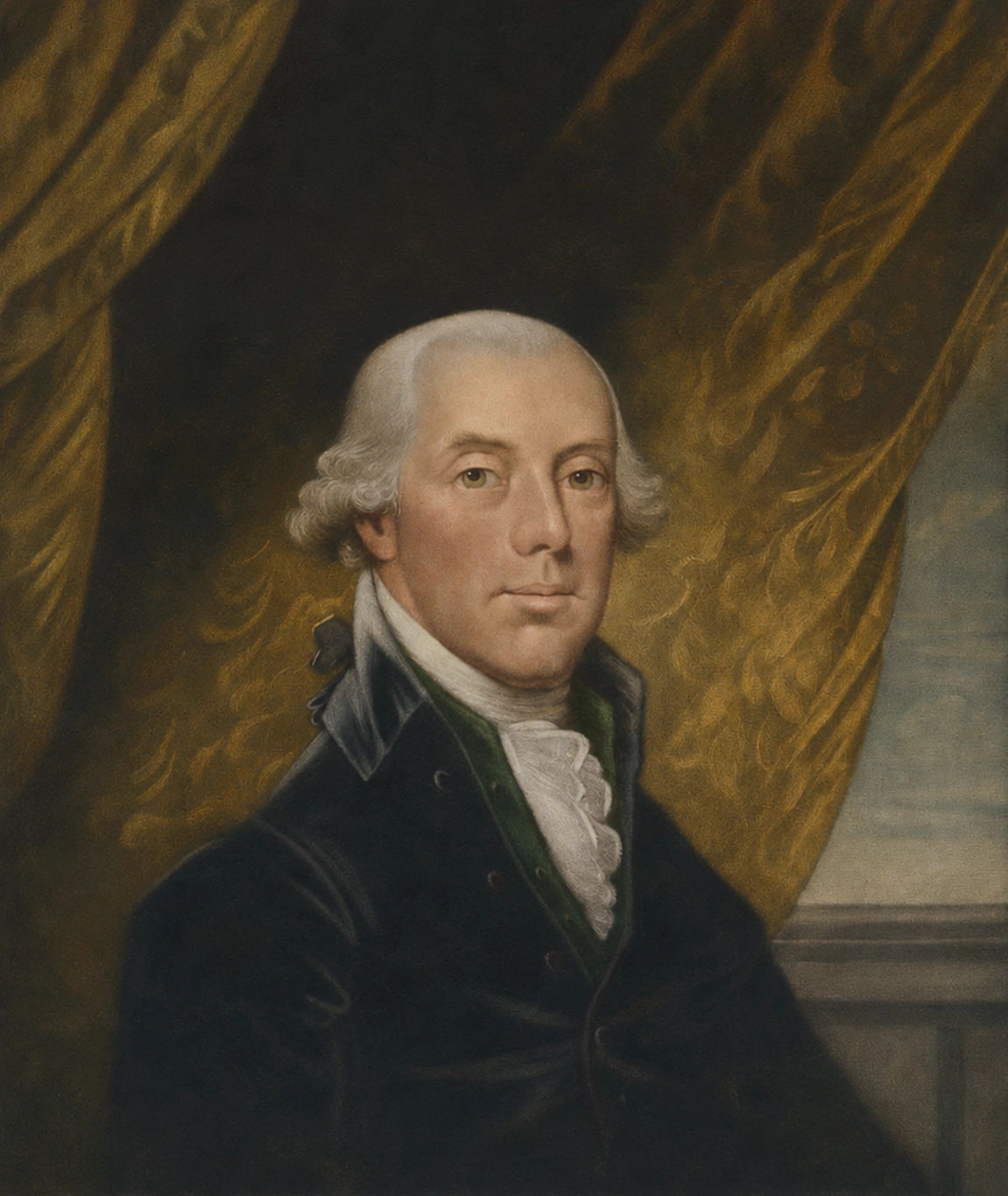
Benjamin Rush | Edward Savage
National Portrait Gallery, Smithsonian Institution
The Philadelphia Doctor served as a Delegate from Pennsylvania at the age of 29 and among the youngest signers of the Declaration of Independence and later helped Pennsylvania ratify the Constitution. A Surgeon General of the Continental Army, Treasurer of the U.S. Mint, Physician, Professor and Abolitionist of the Slave Trade.
Colorized Mezzotint Engraving
1800 | 17 3/8" x 22 3/16"
“Do you recollect the pensive and awful silence which pervaded the house when we were called up, one after another, to the table of the President of Congress, to subscribe what was believed by many at that time to be our own death warrants?”
Letter to John Adams
July 20, 1811
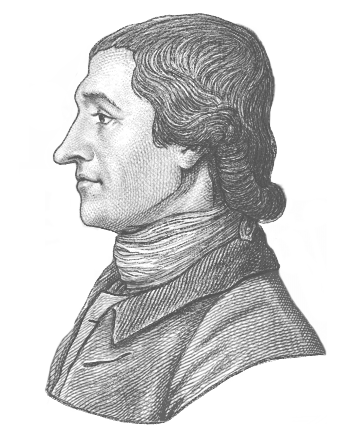
Faithful &
Steady Hand
Charles Thomson
Born in Ireland and orphaned at the age of ten upon his arrival in America, Charles Thomson would grow to become the Secretary of the Continental Congress—a key figure and living record of the American Revolution.
From his attest signature validating the approved Declaration of Independence to one of his final duties—visiting Mount Vernon to inform Washington he had been elected President—his dedicated service and reputation for truth and accuracy formed the saying: “It’s as true as if Charles Thomson’s name were on it.”
In keeping with this sentiment, and reflecting his role in the history of America’s founding, Thomson’s signature has been rightly placed alongside the other Signers.
“Posterity will find your Name so honorably connected with the verification of such a multitude of astonishing facts, . . . in favor of so old, so faithful and so able a public officer, . . . Accept, then, this serious Declaration, that your Services have been important, as your patriotism was distinguished.”
Letter to Charles Thomson upon his Retirement
July 24, 1789
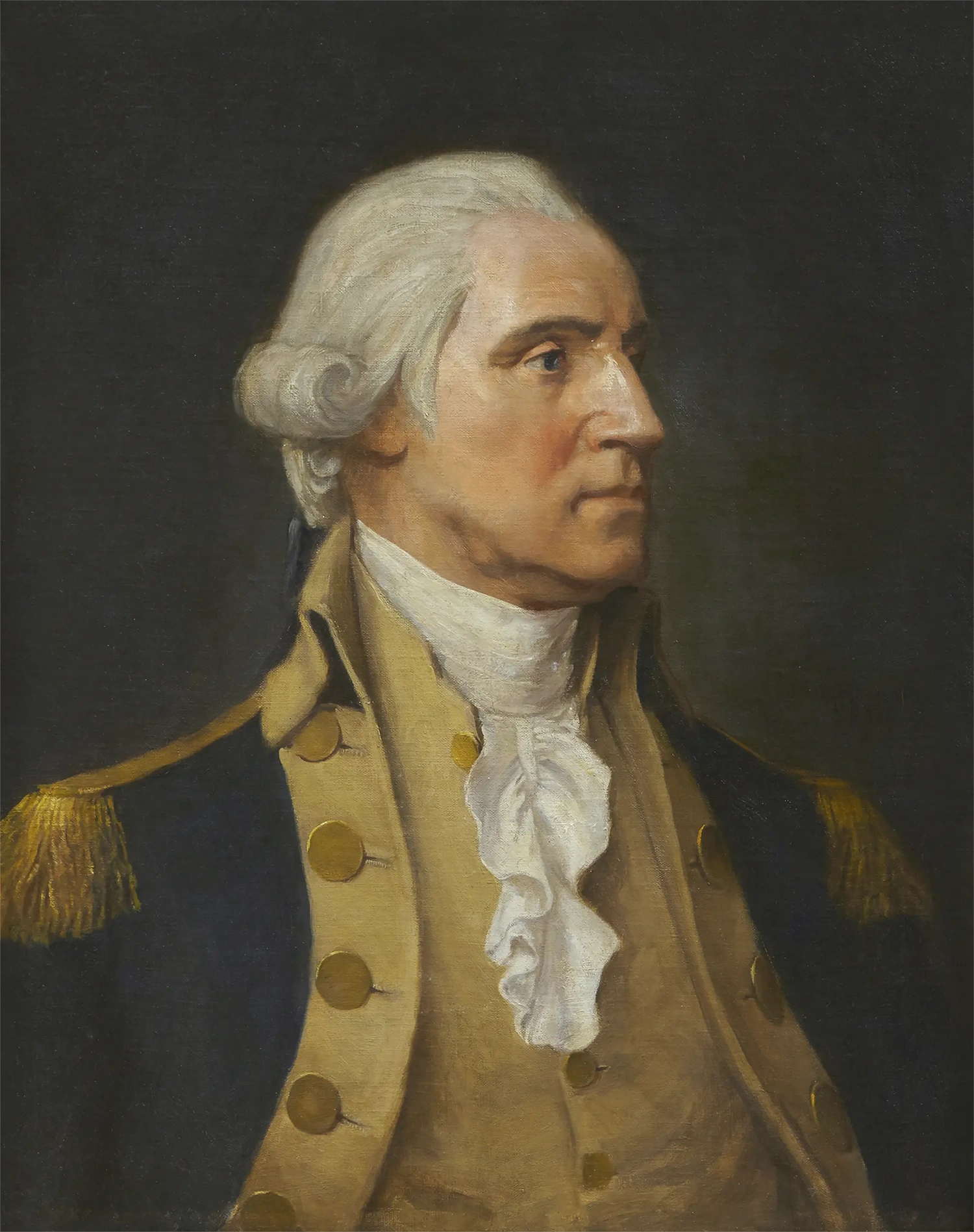
General George Washington | John Ward Dunsmore
Fraunces Tavern Museum, New York
Depicting George Washington in his role as Commender-in-Chief of the Continental Army. Painted by John Dunsmore who was known for authentic portrayals of individuals and events following extensive personal research.
24" x 18"
Our Lives,
Our Fortunes
Sons of America
In the solemn act of signing the Declaration of Independence, the Founding Fathers would lay aside the allegiance of their birth and become Sons of America. The cost of this new loyalty would be the pain and heartache of the Revolutionary War.
From the burning of cherished homes, loss of livelihoods, imprisonment and abuse, to the thunder of the battlefield and the silence of the grave, the price of freedom would be paid by each Father, Mother, Son and Daughter of the Revolution.
It is in this memory that we honor America’s Founding and preserve the vision of “life, liberty and the pursuit of happiness.”